

Europe is rethinking how young people experience the online world. What can football teach us about making digital education more useful, engaging and responsible?
In September 2026, the European Commission presented a proposal for a new KIDS Act, aimed at strengthening the protection of children and teenagers online.
The proposal addresses concerns about digital environments designed to keep young users connected for as long as possible. It calls for stronger safety measures and restrictions on potentially addictive features, alongside age-appropriate access to online services.
The debate is particularly relevant to education. Young people use digital technology every day, but the quality of that experience matters just as much as the time they spend online.
And that raises an interesting question for sport: can a smartphone help young people become more thoughtful, responsible and engaged footballers?
What young athletes actually want
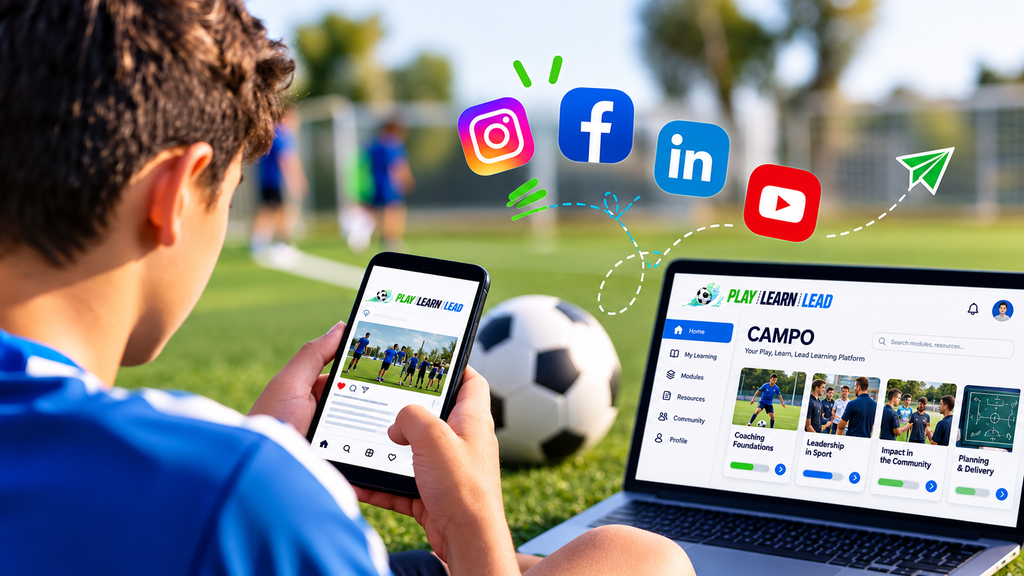
Within Play, Learn, Lead, young athletes from Italy, Poland, Romania and Türkiye have helped shape the concept of CAMPO, the project’s multilingual digital learning platform.
Across the surveys and workshops, a common preference emerged: short videos, interactive activities, quizzes, practical challenges and content connected to real football situations.
In Italy, 18 Under-15 players took part in the initial survey, while 21 young athletes contributed to a workshop at Campo Bruno Barbieri in Rome.
Their feedback pointed towards a digital experience that is simple, visual and easy to access from a smartphone. They also expressed interest in sharing experiences with young players from other European countries.
Coaches and teachers added another important perspective: digital resources should fit naturally into sporting activities and help adults prepare practical learning experiences.
The best digital activity is one that helps young people understand, practise or reflect on something that matters in real life.
From the screen back to the pitch
Imagine a short video showing how a captain responds when a teammate makes a mistake. A young player watches it, answers a question and then faces a similar situation during training.
The real learning happens through the connection between the two experiences.
This approach lies at the heart of CAMPO. The platform is being developed to bring together short learning modules, practical resources, quizzes, challenges and guided reflection within a single educational environment.
Digital safety is also part of that conversation. When young people share stories, videos or experiences online, privacy, responsible communication and appropriate safeguards become essential.
The project’s needs analysis has highlighted the importance of an accessible, manageable learning environment that respects young people’s everyday routines.
Finding the right balance

The current European debate reminds us that digital education is about much more than access to technology.
Good digital learning gives young people a reason to think, interact and apply what they discover. It supports the relationships and experiences that already exist in schools, sports clubs and communities.
For Play, Learn, Lead, that means connecting the phone, the classroom and the football pitch through purposeful activities.
Sometimes the most valuable thing a digital tool can do is encourage a young person to put the phone away and try something new on the field.
Leave a Reply